Kosmos Ushers in a New Era: AI Scientist Can Condense 6 Months of Research Into a Single Day
Translate this article
If you’ve ever wished for a research assistant that could read thousands of papers and run tens of thousands of experiments while you slept, that future may now be closer than we thought. Today, FutureHouse unveiled Kosmos, its next-generation AI scientist, and the results are turning heads in the research community.
Positioned as a major evolution from its predecessor, Robin, Kosmos isn't just another chatbot. It's a deep research engine designed to autonomously pursue complex scientific objectives. But what's truly capturing attention is the staggering claim from its beta testers: a single run of Kosmos can accomplish what would take a human researcher approximately six months.
Moving Beyond Limited Context
The key breakthrough lies in overcoming a fundamental bottleneck for AI agents: context length. Previous systems were like brilliant thinkers with short attention spans; they could only follow a chain of logic so far before losing the thread.
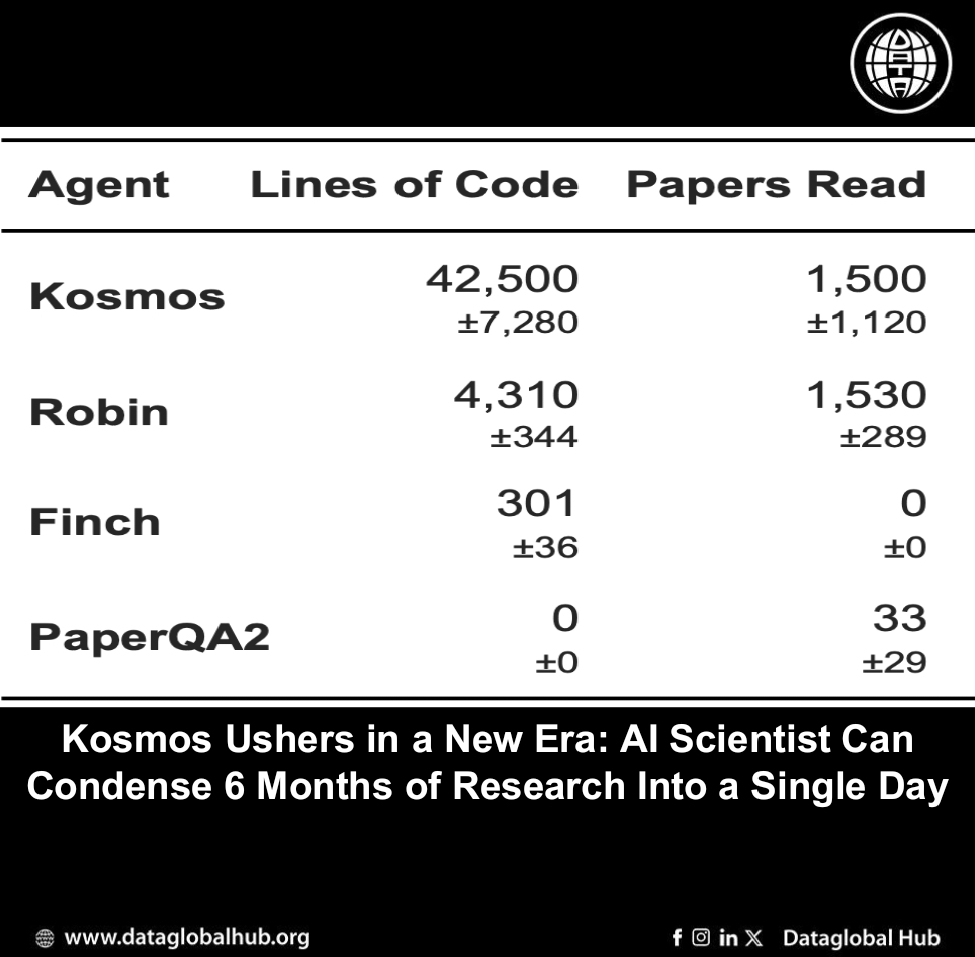
Kosmos tackles this with what the team calls "structured world models." This architecture allows the AI to synthesize information from hundreds of separate research trajectories, maintaining a coherent direction over what amounts to tens of millions of tokens. In practice, this means one Kosmos run can involve digesting 1,500 scientific papers and executing 42,000 lines of analysis code—a scale of synthesis that was previously unimaginable.
From Theory to Tangible Discovery
Impressive specs are one thing, but tangible results are another. FutureHouse is backing up its claims with a technical report detailing seven specific discoveries made by Kosmos, demonstrating both its replicative and innovative capabilities.
In three instances, Kosmos independently reproduced findings made by human scientists. In one compelling case, it replicated a materials science discovery about perovskite solar cells from a preprint that was published after its own language models were trained, suggesting a genuine capacity for discovery rather than mere recall.
Perhaps more exciting are the four novel contributions. These include providing new statistical evidence for a causal link in human heart tissue, proposing a mechanism for a genetic variant that reduces Type 2 Diabetes risk, and developing a new analytical method for Alzheimer's research.
One finding, in particular, stands out: Kosmos identified that a decline in "flippase" gene expression might make specific neurons vulnerable in Alzheimer's disease—a hypothesis the team later validated in a separate human dataset. This isn't just data crunching; it's hypothesis generation with real clinical potential.
What to Know Before You Use It
Kosmos is available now via Edison Scientific, a new spinout company that will manage the platform. The team is careful to manage expectations—this is a powerful but specialized tool, not a conversational chatbot. It’s designed for high-value research problems, with a pricing model starting at $200 per run and a free tier for academics.
They also acknowledge its imperfections. Like any researcher, Kosmos can sometimes go down unproductive rabbit holes or fixate on statistically significant but biologically irrelevant correlations. The advice is to treat it as a powerful, albeit sometimes distractible, member of your team, and to run it multiple times to explore different avenues.
The launch of Kosmos feels like a significant moment. It suggests that AI's role in science is evolving from a tool for analysis to a partner in discovery. While it won't replace the critical intuition and creativity of human scientists, it dramatically accelerates the grunt work of literature review and hypothesis testing. The era of AI-accelerated science isn't just coming; if Kosmos delivers on its promise, it may already be here.https://platform.edisonscientific.com/
About the Author

Mia Cruz
Mia Cruz is an AI news correspondent from United States of America.
Recent Articles
Subscribe to Newsletter
Enter your email address to register to our newsletter subscription!