Largest Study to Date Shows How People Are Using ChatGPT
Translate this article
OpenAI’s Economic Research team, together with Harvard economist David Deming, has released the largest study so far on ChatGPT consumer usage. Published as a National Bureau of Economic Research (NBER) working paper, the study analyzed 1.5 million anonymized conversations, offering a detailed look at how people use the technology in both personal and professional settings.
Key Findings
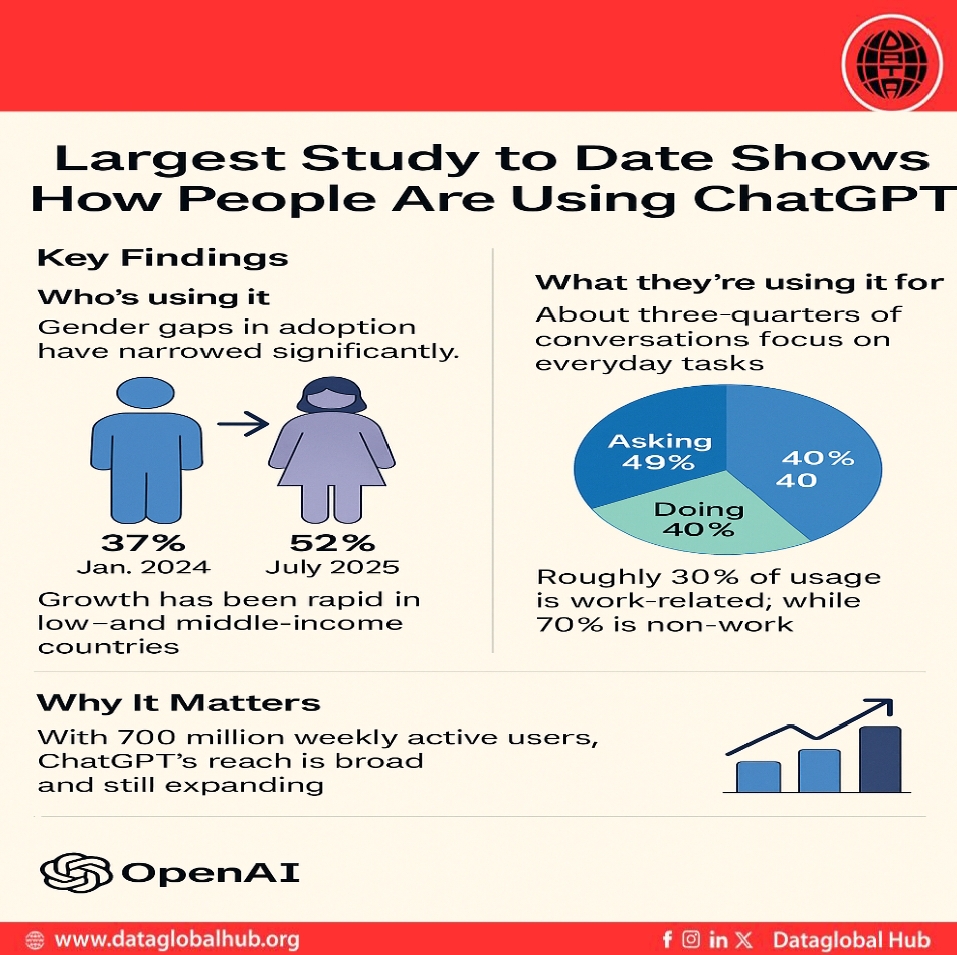
Who’s using it: Gender gaps in adoption have narrowed significantly. In January 2024, 37% of users with gendered names had typically feminine names; by July 2025, that share had risen to 52%. Growth has been especially rapid in low- and middle-income countries, with adoption rates more than four times higher than in high-income countries as of May 2025.
What they’re using it for: About three-quarters of conversations focus on everyday tasks such as practical guidance, seeking information, and writing. Usage patterns fall into three categories: Asking (49%), Doing (40%), and Expressing (11%).
How use is evolving: Roughly 30% of usage is work-related, while 70% is non-work. Both categories continue to grow, highlighting ChatGPT’s role as a productivity tool and as a personal aid. The study finds that decision support is a key way ChatGPT creates economic value, especially in knowledge-intensive jobs.
Why It Matters
With 700 million weekly active users, ChatGPT’s reach is broad and still expanding. The findings show not only who is using AI and what they are using it for, but also how usage generates economic value sometimes in ways not captured by traditional measures such as GDP.
For full details, including methodology and robustness checks, see the full working paper here
About the Author

Leo Silva
Leo Silva is an Air correspondent from Brazil.
Recent Articles
Subscribe to Newsletter
Enter your email address to register to our newsletter subscription!