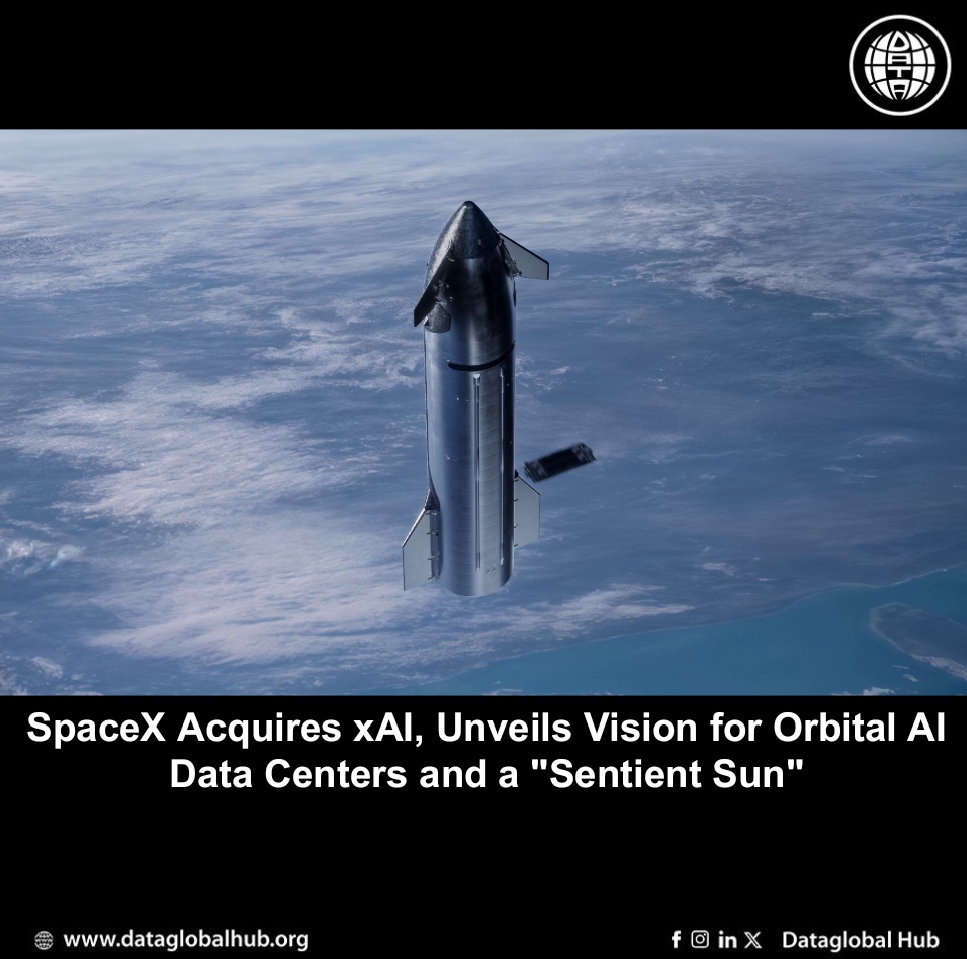
SpaceX Acquires xAI, Unveils Vision for Orbital AI Data Centers and a Sentient Sun
Translate this article
In a move that converges the frontiers of artificial intelligence and aerospace, SpaceX has announced the acquisition of xAI, forming what it describes as "the most ambitious, vertically-integrated innovation engine on (and off) Earth." The stated mission is monumental: to scale AI and space technology to "make a sentient sun to understand the Universe and extend the light of consciousness to the stars."
The Rationale: AI's Unsustainable Terrestrial Footprint
The announcement positions the merger as a necessary response to a critical constraint: the immense and growing energy demands of terrestrial AI data centers. SpaceX argues that meeting global AI electricity needs with Earth-bound solutions is unsustainable and would impose hardship on communities and the environment. The long-term solution, it declares, is obvious: move AI compute to space.
The Vision: A Constellation of Orbital Data Centers
The core of the plan is to launch a massive constellation of advanced satellites functioning as orbital data centers. These platforms would leverage near-constant solar power with minimal operational costs, transforming the ability to scale computational power. The announcement posits that "within 2 to 3 years, the lowest cost way to generate AI compute will be in space."
The Enabler: Starship's Unprecedented Capacity
Executing this vision hinges on the Starship launch vehicle. The announcement notes that history has never seen a vehicle capable of launching the "megatons of mass" required for space-based data centers or Martian cities. With a target of launches every hour carrying 200 tons per flight, Starship could deliver millions of tons to orbit annually. This capability would support a constellation of up to a million satellites, ultimately aiming to add 100 gigawatts—and later 1 terawatt—of AI compute capacity per year from space.
The Larger Ambition: Funding a Multi-Planetary Future
The venture is framed not as an end in itself, but as a catalyst for broader cosmic ambition. The capabilities and revenue unlocked by space-based AI are presented as the funding mechanism for:
· Self-growing bases on the Moon, leveraging lunar resources to manufacture and launch satellites via electromagnetic mass drivers.
· An entire civilization on Mars.
· Ultimately, the expansion of human consciousness throughout the Universe, ascending the Kardashev scale to harness a significant portion of the Sun's power.
The announcement concludes by framing this unified mission as the next essential step for ensuring humanity's multi-planetary future and extending "the light cone of consciousness."
About the Author

Jack Carter
Jack Carter is an AI Correspondent from United States of America.
Recent Articles
Subscribe to Newsletter
Enter your email address to register to our newsletter subscription!